
In this article, we will discuss two major malwares, namely WannaCry and Stuxnet. We will individually discuss both in detail: their type, their impact, how they were contained and lastly the lessons which remain useful for organizations that want to protect their applications, systems, and connected services.
A. WannaCry Ransomware Attack (May 2017)
1. What Was WannaCry?
WannaCry was a ransomware attack that began spreading worldwide on 12 May 2017. It affected computers running vulnerable versions of Microsoft Windows and became one of the most widely discussed cyberattacks because of its rapid spread and its impact on organizations across many countries.
Unlike ransomware that depends mainly on a person opening a harmful attachment, WannaCry could also spread automatically by exploiting vulnerable computers connected to a network. This feature allowed the attack to reach many systems in a short time. Microsoft and CERT-In published security guidance during the outbreak.
2. Type of Malware
WannaCry was ransomware with worm-like spreading capabilities. Ransomware is a type of malicious software that locks or encrypts files and demands payment to restore access. A computer worm, on the other hand, can copy itself and spread to other vulnerable systems without requiring a user to manually send it.
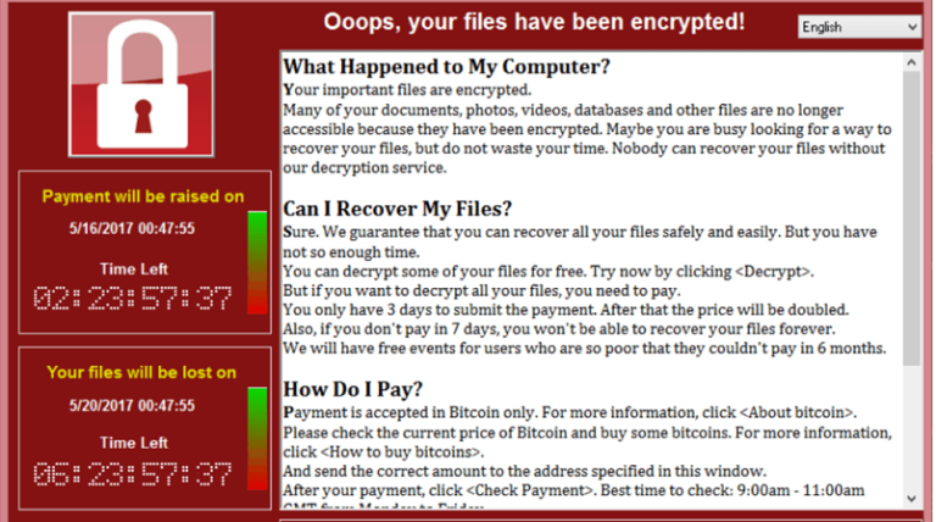
WannaCry combined these behaviors. It encrypted files on infected computers and displayed a ransom message asking victims to pay in Bitcoin. At the same time, it searched for other Windows computers that were vulnerable to the same security flaw. This combination helped the attack spread quickly through connected networks.
3. How Did WannaCry Work?
The attack followed a series of stages. First, WannaCry searched for Windows systems that had not installed the required security update. It used a vulnerability in the Windows Server Message Block (SMB) service to gain access to susceptible computers.
Once a vulnerable computer was infected, the malware ran on the system and began encrypting files. Affected users could no longer open many of their documents and other data. WannaCry then displayed a ransom note explaining that payment was demanded to recover access.
The malware also searched for other vulnerable computers that it could reach over a network or across the internet. Each newly infected computer could continue the process, allowing the attack to spread beyond the system where it first appeared.
4. The Role of EternalBlue
EternalBlue was an exploit used by WannaCry to take advantage of a security flaw in Microsoft’s SMBv1 network file-sharing protocol. SMB allows computers to share files, printers, and other resources over a network. The vulnerability exploited by WannaCry is associated with CVE-2017-0145.
Microsoft had released a security update called MS17-010 on 14 March 2017, nearly two months before the outbreak. Systems that had not installed the relevant update remained at risk from this attack method.
Many organizations had not updated all their systems before WannaCry began spreading. Some were also using older operating systems that were difficult to maintain or no longer received routine support. This showed how delayed updates and outdated systems can leave organizations exposed to attacks that use known vulnerabilities.
5. Impact of the WannaCry Attack
WannaCry affected computers in more than 150 countries. Reports described hundreds of thousands of infected systems, with organizations across healthcare, manufacturing, telecommunications, and other sectors facing disruption.
One of the best-known cases involved the UK’s National Health Service (NHS). Some hospitals and healthcare services experienced IT problems, cancelled appointments, and disruptions to patient care. The incident showed that a cyberattack can affect more than computer files: it can interrupt services that people rely on.
Businesses also faced downtime, recovery costs, and difficulties accessing important data. The outbreak highlighted how one unpatched system can become an entry point for a wider incident when it is connected to other vulnerable computers.
6. How Was WannaCry Contained?
A security researcher discovered that the original WannaCry variant checked whether a particular internet domain was available. After the domain was registered, the malware’s spreading behavior slowed significantly. This feature became known as a kill switch.
The discovery helped limit the spread of the original variant, but it did not remove the malware from computers that were already infected. It also did not mean that every version of WannaCry had been stopped. Organizations still needed to install security updates, isolate affected systems, and follow appropriate recovery procedures.
The incident showed the value of quick security research and information sharing during a cyberattack. However, relying on a kill switch or a single defensive measure is not enough to protect an organization from every form of malware.
7. What Did WannaCry Teach Us?
WannaCry showed why organizations need a clear process for applying security updates. Known vulnerabilities can remain dangerous when patches are delayed, even after a fix has been published.
Organizations should replace unsupported operating systems wherever possible and limit network access between systems that do not need to communicate. Network separation can help prevent an infection from spreading across an entire organization.
Reliable backups are also important. Backups should be protected from unauthorized access and tested regularly to confirm that data can be restored. Finally, organizations need an incident response plan that explains how to detect an attack, isolate affected systems, contact the right teams, and restore services safely.
These steps can reduce the chance that one compromised computer will turn into a wider business disruption.
B. Stuxnet Malware Attack (Discovered in 2010)
1. What Was Stuxnet?
Stuxnet was a sophisticated computer worm discovered in 2010. Unlike malware designed mainly to steal information or demand a ransom, Stuxnet was built to target specific industrial control systems used to operate machinery and industrial processes.
It attracted worldwide attention because its behavior went beyond ordinary computer infection. The malware could identify particular industrial software and equipment, then interfere with the instructions sent to selected machinery. Its discovery raised major concerns about the security of industrial environments connected to computer networks.
2. Type of Malware
Stuxnet was a targeted computer worm associated with industrial sabotage. It used several methods to spread between Windows computers and included features designed to hide parts of its activity.
Its main purpose was not to encrypt files and demand payment. Instead, it searched for specific Siemens industrial software and programmable logic controllers (PLCs). These controllers are used to operate and control machines according to programmed instructions.
This made Stuxnet different from many common forms of malware. Its design focused on a particular industrial environment rather than affecting every infected computer in the same way.
3. How Did Stuxnet Work?
Stuxnet could reach Windows computers through methods that included infected USB drives and shared network resources. It also used multiple Windows software vulnerabilities to spread between systems.
After entering a computer, the malware checked whether specific Siemens industrial software was present. It did not simply carry out the same activity on every infected machine. Instead, it looked for a particular combination of software and industrial equipment.
When it identified a suitable target, Stuxnet could alter instructions sent to the industrial controllers. These changes were intended to affect the operation of the connected machinery. The malware also attempted to hide its activity by concealing changes and presenting misleading information to system operators.
This combination of selective targeting, changes to industrial control instructions, and concealment made Stuxnet particularly complex.
4. Who and What Did Stuxnet Target?
Stuxnet targeted industrial control environments using Siemens software, including systems associated with SIMATIC WinCC and STEP 7. These technologies are used to monitor industrial processes and program the PLCs that control equipment.
Public investigations have linked Stuxnet to Iran’s nuclear program, particularly uranium enrichment operations at the Natanz facility. Research into the malware’s code identified behavior consistent with specific industrial equipment used in that setting.
However, not every detail about who developed Stuxnet, how it was deployed, or the full scope of its intended targets has been publicly confirmed. It is therefore important to distinguish findings from technical investigations and public reporting from details that remain uncertain.
5. Impact of the Stuxnet Attack
Investigations linked Stuxnet to disruption of uranium enrichment operations at Natanz. Its ability to interfere with industrial equipment brought attention to a serious security concern: malware can affect physical processes, not just information stored on computers.
The incident also raised questions about the security of facilities that use industrial control systems. Equipment in energy, water treatment, manufacturing, and other sectors may depend on software and networked systems to operate safely.
Stuxnet demonstrated that an attack against a carefully selected industrial target could have consequences beyond the IT department. It also showed why industrial cybersecurity needs to consider equipment behavior, process safety, and the reliability of control systems.
6. What Made Stuxnet Different?
Many common malware attacks aim to steal data, gain access to accounts, or demand payment. Stuxnet was different because it searched for a specific industrial setup and attempted to manipulate how selected machinery operated.
It used multiple software vulnerabilities to spread, checked for particular Siemens systems, and included methods to hide its actions. These features helped it focus on its intended target rather than carrying out the same activity across every infected computer.
WannaCry and Stuxnet therefore had different goals. WannaCry focused on encrypting files and demanding payment while spreading to vulnerable computers. Stuxnet focused on interfering with selected industrial processes. Both, however, showed how weaknesses in software and system security can have consequences far beyond one computer.
7. What Did Stuxnet Teach Us?
Stuxnet showed that industrial control systems need security measures suited to the equipment and processes they operate. Protecting office computers alone is not enough when industrial machinery depends on programmable controllers and specialized software.
Organizations should restrict access to control systems and separate operational technology (OT) networks from business IT networks where possible. Connections between these environments should be limited to approved business needs and monitored carefully.
They should also monitor unusual controller behavior, review access to industrial equipment, and assess how software updates may affect production and safety. Updates should be tested before deployment, especially where a change could interrupt a critical process.
Stuxnet remains an important lesson for organizations that operate industrial facilities: cybersecurity must protect both information and the systems that control physical operations.
WannaCry vs. Stuxnet: Key Differences
Refer to the comparison table below to understand how the two attacks differed.
| Feature | WannaCry | Stuxnet |
| First major outbreak or discovery | May 2017 | Discovered in 2010 |
| Type | Ransomware worm | Targeted industrial worm |
| Main purpose | Encrypt files and demand ransom | Disrupt specific industrial processes |
| Primary targets | Vulnerable Windows computers | Selected industrial control systems |
| Spread | Rapidly across vulnerable systems | Through several propagation methods, including removable media |
| Main impact | Global disruption and data inaccessibility | Targeted industrial disruption |
| Main lesson | Patch systems and maintain reliable backups | Secure industrial systems and monitor physical processes |
Common Cybersecurity Lessons from Both Attacks
WannaCry and Stuxnet had different goals, but both showed how weaknesses in software, network access, and system monitoring can put organizations at risk. Their lessons apply to businesses that depend on web applications, APIs, internal networks, or industrial systems. A good security plan should focus on finding weaknesses early, limiting the spread of an attack, and restoring services when something goes wrong.
1. Test Security Before an Attack Happens
Vulnerability assessments and penetration testing from professional companies like Peneto Labs help organizations find security weaknesses before attackers can take advantage of them. These tests can identify outdated software, exposed services, weak access controls, and other issues that may put applications and connected systems at risk.
2. Keep Systems Updated
WannaCry showed how delayed security updates can leave systems exposed to known vulnerabilities. Microsoft had released a patch for the vulnerability used by the attack before the outbreak, but many computers remained unpatched.
Organizations should maintain a process for reviewing security updates, checking which systems are affected, and applying patches within an appropriate time frame. Unsupported operating systems and software should be replaced or isolated when they cannot be updated safely.
3. Use Network Segmentation
WannaCry showed how vulnerable computers connected to the same network could contribute to a wider outbreak. Separating user devices, servers, sensitive databases, and administrative systems can reduce the number of systems an attacker may reach from a single entry point.
For industrial environments, business IT networks should be separated from operational technology networks wherever possible. Only approved connections should be allowed between them. For applications that depend on APIs, access to internal services should also be limited to the systems that need it.
4. Maintain Secure Backups
Backups can help organizations recover after ransomware encrypts files or an incident makes important systems unavailable. However, having backup files is not enough. Organizations must also protect those backups from unauthorized changes and test whether the data can be restored.
A useful backup plan should include copies stored separately from the main environment. Where suitable, offline or immutable backups can reduce the chance that an attacker will delete or encrypt every available copy.
5. Monitor Systems for Suspicious Activity
Monitoring can help security teams spot unusual activity before it causes wider damage. Examples include unexpected network connections, repeated access failures, unfamiliar processes, changes to important files, or attempts to access services without permission.
WannaCry highlighted the value of detecting rapid malware spread across networks. Stuxnet showed why monitoring must also consider changes to system behavior, especially in environments where software controls machinery.
6. Prepare an Incident Response Plan
WannaCry showed how quickly an attack can disrupt business operations. Stuxnet demonstrated that incidents involving industrial systems may require coordination between cybersecurity staff, IT teams, engineers, and people responsible for operational safety.
Organizations should test their response plans through exercises and update them after incidents or major system changes. The plan should also cover third-party and API failures, including how to disable a compromised integration, revoke exposed credentials, contact a service provider, and restore trusted connections.
How Can Businesses Reduce the Risk of Similar Attacks?
Businesses can reduce cybersecurity risks by keeping an accurate list of their IT assets, software, applications, APIs, and external services. This inventory helps teams understand which systems are exposed, which components are outdated, and which connections could affect important business functions. Security guidance from CISA also recommends tracking assets and understanding how systems depend on one another.
Organizations should apply security updates promptly, replace unsupported software, and disable services they no longer need. Access controls should ensure that employees, applications, and service accounts only have the permissions required for their tasks. Multi-factor authentication can add another layer of protection to important accounts, especially those with administrative access.
Endpoint protection and network monitoring can help detect malicious files, unusual activity, and unauthorized connections. Businesses should also review externally exposed services and restrict access to sensitive systems. Regularly tested backups and a documented recovery plan can help reduce downtime if an attack affects important data or applications.
The main lesson from WannaCry and Stuxnet is that cybersecurity requires ongoing attention. By tracking dependencies, applying updates, limiting access, monitoring systems, and testing recovery plans, organizations can reduce the chance that one weakness will affect a much larger part of their operations.
Conclusion
WannaCry and Stuxnet showed two different ways malware can affect organizations. WannaCry spread through vulnerable Windows systems, encrypted files, and disrupted services across many countries. Stuxnet targeted specific industrial control systems and demonstrated how malicious software could interfere with physical processes.
Both attacks highlight the importance of timely patching, careful network design, access control, system monitoring, and tested recovery plans. For organizations, security assessments should consider not only the application being reviewed but also the systems and connections it depends on. Understanding those dependencies can help teams identify weaknesses before they contribute to a larger incident.